Friday, January 14, 2011

Montalcino

Montalcino
One of the most historic regions in all of Italy, especially for its wines, the medieval castle city of Montalcino is outdone by none in its seductive culture and aura.  A place of tradition and purity, experience firsthand what a pure Sangiovese can taste like.  Both the famous Brunello’s and the Rosso’s of Montalcino are exactly that, pure Sangiovese.  One really gets a great sense of just how powerful yet graceful the wines from this region are when visiting a historic winery and allows themselves to become immersed in the charm that is Montalcino.  Although only a very short distance from the city of Siena, Montalcino has a nostalgia that is all its own.  Enjoy some time inside the walls of the old hilltop city and take the opportunity to visit some of its local shops and get a true feel for something a bit removed from the normal for many visitors to beautiful Tuscany.  This is a destination that should be on everyone’s itinerary, especially a true lover of wine, because the seductive charm of the culture that is Montalcino is one not to be passed on.    

Bolgheri

Bolgheri

What can one say about the fabled birthplace of the ‘Supertuscan’ wines?  Truly a wonderful place, not only for its wines, but for its ambiance all around.  Rows of Cypress' and Pines lining the sides of roads, grove of olive orchards, and of course seas of some of the best grape vines in all of Italy.  The scenery alone is worth the many pictures you surely will take.  And the wines, well, the wines will leave lasting memories of a holiday that can be unmatched.  Many the world round know of the fabled Sassicaia, the wine of Tenuta San Guido, the first of the ‘Supertuscan’ wines first produced over 40 years ago now.  But in the land of the –aias’ there are a vast number of other luxury wineries to be discovered.  A day visiting wonderful wineries and tasting some of the best that Bolgheri has to offer while enjoying the magnificent views of the beautiful Tuscan coast, what more could one dream of?  So come and truly experience why this part of Tuscany is indeed so ‘Super.’

Thursday, January 13, 2011

Chianti Wine Styles

Wines Styles of Chianti
More people know the wine Chianti than any other in all of Italy.  Most people know very little about the wines of Chianti though.  For instance, to begin, Chianti is a place and not a wine per say.  Like every other red D.O.C.G. wine in Italy, the wines bearing the Chianti designation are Sangiovese based.  But when we talk of Chianti wines here, we are not including the low quality fiasco bottles covered in the straw baskets.  We are talking high quality, real reputation bottlings by some of the most famous families in all of Italy.  Families like the Antinori’s and the Frescobaldi’s have history’s that can be documented back for over 500 years.  And the Ricasoli family, well they can be attributed with developing the modern recipe for Chianti in the 1870’s.  This family is still a very strong player also, making high class wines at their estate, Castello di Brolio. 
The original region, which is now classified as the Chianti Classico, was identified as far back as the 14th Century as the hills beginning to the south of Florence and stretching south to Siena.  The major communes then, and still today, are Greve, Radda, Gaiole, and Castellina, all of which are wonderful old world towns rich with history and inhabited by fabulous enoteca ready to pour their best local products.  The Medici family, one of the most powerful in Italian history, created the first governmental legislation concerning wine and Chianti in 1716, when Grand Duke Cosimo III de’ Medici identified these four communes as high quality production zones for this wine.  Today there are 8 zones for Chianti, the Classico region as define previously, as well as 7 other zones which can be made into base labeled Chianti or bear the name of its designation.  The most famous and highest quality is Chianti Rufina, which is east of Florence.  Here you will find top quality producers like Selvapiana and Frescobaldi, who’s Nipozzano Riserva is always a smart buy.  The others are Chianti Colli Aretini near Arezzo, Colli Fiorentini between Classico and Rufina, Colli Senesi which covers over Siena, Montalbano to the west of Florence, Colli Pisani which encompasses Pisa, and Montispertoli which is west of the Classico region. 
On many bottles of Chianti Classico these days you will see the Gallo Nero, or the Black Rooster.  This is the symbol of the Consorzio of Chianti Classico, a group of member producers who are dedicated to not only improving their wines but the reputation of the whole of Chianti Classico by increasing education and improving the vineyards and cellars.  While any producer whose vineyards are located within the designated zone may use the Chianti Classico label, the Gallo Nero is a member’s only badge, and is almost always a sign of quality in the bottle.
Vin Santo is another wine that you will encounter throughout the Chianti regions.  This is the famous dessert wine of the region, made from a blend of Trebbiano and Malvasia grapes mainly that are dried for 3-6 months after harvest and before pressing.  The wine is then placed into small barrels which do not exceed 3-5 hL on average.  The wine is aged and never topped off, thus creating a quite unique taste and character all its own.  Have a glass after dinner and dip one of the local specialty biscotti into it and dessert is thus served.
Chianti Classico D.O.C.G.
 Originally defined back in 1716 by Grand Duke Cosimo III de’ Medici, this is the area between Florence and Siena.  A D.O.C. in 1967, and a D.O.C.G. in 1984 the region received major legal revisions in 1996 so as to update the requirements for these wines.  Today the blend is still Sangiovese dominant, and the majority of the Sangiovese grown here is of the Sangioveto clone, which is smaller and has thinner skin compared with The Grosso of Montalcino or Prugnolo of Montepulciano.  This combined with the traditional Galestro soils of the Classico region delivers a highly perfumed wine that is very dry and bright with acidity.  Blending is allowed here, and until 2006 one could actually blend some white wine into the mix to raise the aromatic levels, but this is now forbidden in Classico wines. 
Sangiovese from a minimum of 75% -100% is allowed, Canaiolo Nero maximum 10%, and other authorized varietals maximum 15%.  These ‘other grapes’ are most commonly Merlot and Cabernet Sauvignon which are used to improve color and darken the flavors of the wine on the nose and palate, they soften the natural dryness and acidity of the Sangiovese.  Chianti Classico must wait until October 1st following the harvest to be released, and wines with the Riserva label must wait 26 months from January 1st following the harvest, including a minimum of 2 years in barrel and 3months in bottle. 
Chianti D.O.C.G.
As with Chianti Classico, many of the restrictions are the same here.  In fact, a Chianti Classico could be simply labeled as a Chianti D.O.C.G., but this almost never happens.  As I mentioned, this is a catch all that covers the 7 sub zones of the current Chianti area.  There are a few minor differences based on slightly less stringent regulations for a Chianti wine.  A Chianti wine must only wait until March 1st following the harvest to be released onto the market, with the exception of the wines from Rufina, Fiorentini, and Montespertoli which must wait until June 1st.  For Riserva wines the aging is the same as Classico wines. 
Sangiovese is present from 75%-100% in the blend.  Canaiolo Nero with a maximum of 10%, other authorized red varietals maximum 10%, and Trebbiano and/or Malvasia at a maximum of 10%.  Here is the big difference with the Classico region, as there are still white grapes permitted into the blend of these Chianti wines.  Most producers no longer participate in this practice, but nonetheless it is still available. 
Vin Santo del Chianti & Chianti Classico D.O.C.
The ‘Holy Wine’ of Tuscany as it has been served as the wine of mass by Catholic priests at times.  Today it can still be deemed a spiritual experience as it is the most well known and recognized dessert wines to come out of Italy.  The sweetness of the wine countered with the dryness of the cookie, it works so well together it would be a shame to have one without the joy of the other to accompany along.  As stated before the grapes are dried and then pressed, and the wine itself is fermented and aged for long periods in small casks without ever being topped off.  In general, a Vin Santo will be golden amber in color and rich in its intensity of aromas.  There are notes of toffee and caramel with dried preserved dates and figs accompanied by the tinge of almond on the finish.
Trebbiano and/or Malvasia Toscana minimum 70%, other authorized white grapes maximum 30%.  The most common ‘other’ grape would be Grechetto, which is most famous for its use in Umbria for the wines from Orvieto.  The grapes are dried and then pressed, the juice being put into small casks of a maximum of 5 hL to ferment and age.  The barrels are never topped off during this time.  Normale wines are aged a minimum of 3 years, with Riserva wines going a minimum of 4 years. 
Due to the length of time and low quantity able to be produced each year, these wines are not so common, and can be expensive at times.  That said, a good reputable Italian Restaurant should offer one by the glass to experience.
Toscana I.G.T.
This is a true catch all label, as it covers the whole of Tuscany.  I include it here because many famous and respectable wines from the Chianti region are being made in ways that do not allow them to claim any other higher designation, yet.  Take the famed Antinori family.  In 1971 they released a wine named Tignanello, one of the first ‘Supertuscan’ wines on the market.  The blend is almost always around 80% Sangiovese and 20% Cabernet Sauvignon.  This wine is produced from vines on their estate property in Chianti Classico but does not conform to the Chianti Classico D.O.C.G. laws, not then and not now.  This is just one example of course, but it gives you an idea.  Remember that, like in many of the newly defined regions in Tuscany, some of the best wines do not yet conform to laws as they have been laid out.  In time there is great belief that they will.  The best thing to do is to go with trusted producers or professional recommendations when contemplating a wine labeled with one of these catch all appellation.  Don’t be afraid to experiment though, as you may be pleasantly surprised by what you find. 

Cabernet Sauvignon

Cabernet Sauvignon (Kab-bur-neh Saw-vin-yan)
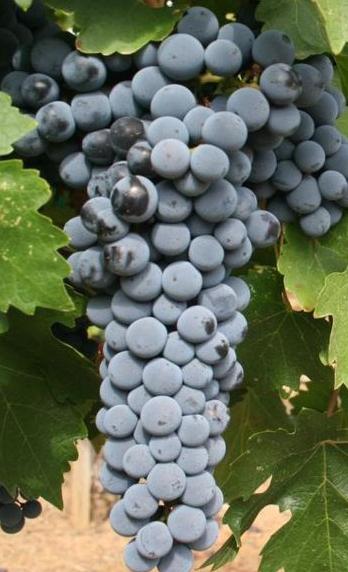
File:Red Mountain Cabernet Sauvignon grapes from Hedge Vineyards.jpg
This grape is the most important International Varietal in Tuscany these days.  One would think that it does have quite a recent history in the region, but actually, Cabernet Sauvignon has been an important grape for quite some time.  The region of Carmignano, D.O.C.G. as of 1990, is located in Northwest Tuscany on the eastern slopes within the Chianti Monte Albano commune, and has been using Cabernet Sauvignon into its blend for hundreds of years.  In 1716, the Carmignano region was designated, along with Chianti, as a original controlled production zone by Grand Duke Cosimo III de’ Medici.  After the phylloxera epidemic in the late 19th Century, many producers found refuge in this variety within their vineyards as a means to begin to recover and produce quality wines again.
More widely recognized these days for Cabernet Sauvignon is the coastal region of Bolgheri in the Northern Maremma.  Here you have the fabled story of Mario Incisa della Rocchetta and the Tenuta San Guido estate, the home of Sassicaia.  From this site, where a small plot of Cabernet Sauvignon was planted in 1944 by Mario, you have the birth of the famed ‘Supertuscan’ wines some 20 years later.  The 1968 Sassicaia, the first vintage released to the public market, is the original ‘Supertuscan’ wine.  Many have followed in these footsteps and as of 2010 there are about 50 producers within the Bolgheri D.O.C. region.  While not all ‘Supertuscan’ wines are Cabernet Sauvignon based, the majority are-including most of the big names like Sassicaia, Ornellaia, Solaia, Grattamacco Rosso, Guado al Tasso, etc.  Cabernet Sauvignon has proved itself to be such a quality grape in Tuscany that it has spread throughout the region.  Many Chianti and Chianti Classico wines will have a percentage blended in, as well as many of the Vino Nobile di Montepulciano wines.  The grape is also gaining a strong preference in the Southern Maremma as well, where many of the producers have found it to do quite well in the warm southern sites.  While still Sangiovese territory, a large quantity of high class Maremma Toscana I.G.T. bottles containing majority Cabernet Sauvignon are continuing to grow in the market. 
The grape itself is a small berry with a thick skin naturally high in tannin compounds, thus the dark colors and high tannins inherit in the wines derived from Cabernet Sauvignon.   Like all wines, the productions methods will alter the flavors, but this Sommelier looks for the common characteristics of dark berries backed by some form of vegetative qualities and a strong mineral impression.  The grape does best on gravelly soil rich in hard minerals, thus its success in Bordeaux-especially the Haut Medoc- as well as the hills of Bolgheri and in California’s Napa and Sonoma Valleys.  The wine is often aged in oak barrels which will impart notes ranging from smoke and toast to vanilla, cedar, and cigar box qualities.  I also look for mint/eucalyptus notes in addition, as well as notes of balsamic vinegar in the Cabernet Sauvignon based wines from Tuscany. 

Montalcino Wine Styles

Wine Styles of Montalcino

One of the most famous wines, not only in Italy but the world, the Brunello di Montalcino is a wine rich with history and deep with flavors.  A pure wine, in that it is the only D.O.C.G. in Tuscany that calls for 100% Sangiovese; nothing else is allowed into these wines.  And furthermore it must be the ‘Brunello’ clone of Sangiovese, also known as Sangiovese Grosso.  Compared to the vines in much of the Chianti wines, Brunello is characterized for having larger size berries and thicker skins to those berries.  Why is this important?  It is these two qualities which give the wines of Montalcino, the Brunello’s and the Rosso’s, the darker flavor profiles and also the stronger tannin structure-a key component in the reason for the aging capacity of the Brunello wines.  Another key distinction for the wines of Montalcino is location.  South of Chianti Classico and West of Montepulciano, the city enjoys the best exposure to climate in most years.  They get more warmth than the other two wines, but also because the city is closer to the sea, Montalcino also enjoys more of the coastal influence as well.  Put simply, it’s a perfect marriage for the vines.
The story of the Brunello di Montalcino starts over a century and a half ago with the grandfather of Brunello you could say, Clemente Santi.  Many credit him with isolating the Brunello clone in his own vineyards as far back as the 1840’s on the family estate, Il Greppo.  Later on his grandson, Ferruccio Biondi, returned to the family estate and continued the work of developing Brunello and in 1888 Biondi-Santi Brunello di Montalcino was born.  There are a few other names from these old times, but this estate was definitely the head of the class.  In 1956 there was a terrible freeze that threatened to wipe out the vineyards and olive groves of many, leaving only a few producers in the region.  In 1980 the wine from Montalcino was granted the highest distinction in Italian wine law, the D.O.C.G. which set very specific standards that must be adhered to in order to use the title.  Today, as the wines have gained even more international acclaim and the number of producers has grown, the wines of Montalcino are still some of the strictest wines in all of Italy to produce.  Look for wines that are darker in color and fuller than traditional Chianti’s in aromas.  Beautiful wines that are the epitome of the Sangiovese grape. 

Brunello di Montalcino D.O.C.G.
The first granted, and one of the original 4 D.O.C.G. wines passed in 1980, Brunello is held to the highest standards in production methods.  These requirements are almost always further intensified by the producer themselves wanting to deliver the highest quality wine possible.  Yields are kept extremely low in the vineyard, and what does get delivered to the winery each harvest is meticulously sorted to select only the finest grape bunches.  D.O.C.G. law has set forth one of the longest aging requirements of any dry still wine in Italy, 4 years for normale and 5 years for the Riserva wines from January 1st the year following the harvest.  For example, a 2004 Brunello normale may be released on Jan 1st 2009, the Riserva on Jan 1st 2010.  Every Brunello must be 100% Sangiovese Grosso (Brunello clone) and nothing else.  All Brunello wines must be aged for a minimum of two years in oak barrels plus at least 4 months in bottle for normale and 6 months for Riserva wines.  This may seem like a long time but Brunello di Montalcino is a wine built for aging and can still be a tight restrained wine upon release.  Great examples of this wine can age for well over 20 years and still be in perfect harmony.

Rosso di Montalcino D.O.C.
 It is very difficult for both the producer and the consumer to wait 5 years to begin to enjoy the wines of Montalcino, and so in 1983 (November 25) the D.O.C. regulators after listening to the people of Montalcino granted the Rosso wines of the region elevated status into the ranks of the D.O.C.  For producers this meant that they could use their younger vines for these Rosso wines and as a result reserve the best fruit for their Brunello wines.  The Rosso label corresponds to the same region as defined for the Brunello D.O.C.G. and must also be comprised purely of the Brunello clone of Sangiovese (Grosso).  The big difference is in the aging requirements, which only ask for 1 year of aging before release as opposed to the 4 year minimum for Brunello wines.  Think of these wines as softer and easier to approach than the big bold brooding Brunello wines, and are considered to be great values especially in good vintages. 

Sant’Antimo D.O.C.
This region is named after the famous abbey of Sant’Antimo and the region is encompassing of all of Montalcino.  Created effective for the 1996 vintage, it is the effort to recognize the whole of Montalcino as a commune that produces quality wines.  The Sant’Antimo D.O.C. can be applied to white and red wines as well as the specialty dessert wine of Tuscany-Vin Santo.  The label is in effect giving acclaim to the vines other than Sangiovese Grosso grown in Montalcino, international varietals like Cabernet Sauvignon, Merlot, and Chardonnay to name a few.  It gives a winemaker free will to experiment and create good wines which were not common until very recently.  The laws are very lenient here; the major point to make is that a varietal wine must be at minimum 85% of said varietal. 


Maremma Wine Styles

Wine Styles of the Maremma
When most people think of Tuscan wine one word comes to the front of everyone’s mind-Chianti.  And while this is indeed the most well known of the regions of Tuscany there is a lot to know and explore beyond just Chianti.  The Brunello wines of Montalcino, the Nobile wines of Montepulciano, and of course the various wines styles of the Southern part of Tuscany, the Maremma.  It has often been common in the past to think of this area as the land between Rome and Florence/Siena, but there is a lot going on here, trust me.  Based in the commune and around the major city of Grosseto, there are 3 major wine areas to discuss.  They are commonly referred to together as the Mo-Mo-Mo wine group.  This stands for Morellino-Monteregio-Montecucco.  All three have in fact become very big players in the Tuscan wine game, and will be showing up a lot more in the next few years on store shelves and restaurant menus as they are recognized for being great value wines of high quality.  Also there are the white wines of the region which are achieving much higher quality levels and are very exciting varietals as well. 
An important aspect of this region to note is the difference in its climate compared to the other major regions in Tuscany.  Often nicknamed the ‘California of Italy’ you have very warm summers that are cooled by the ocean breezes which created a perfect environment for the ripening of quality wine grapes.  Within the commune there are differences in the soils which also give different profiles to each of the Mo-Mo-Mo wines.  Maybe you have not yet experienced one of these wines, but once one does they understand why they are the hidden gem of the Tuscan region…for now that is.

Morellino di Scansano D.O.C.G.
A D.O.C.G. all the way down here in Tuscany, that is right.  Granted D.O.C. in 1978 and elevated to D.O.C.G. in 2006 (November 29) the region is centered round the city of Scansano to the Southeast of Grosseto.  Morellino is the regional name for Sangiovese which is the majority grape in the Morellino blend, at a minimum of 85%.  Other authorized grapes can be used up to 15%; the common varietals are Ciliegiolo (an indigenous varietal closely related to Sangiovese), Merlot, Syrah, and Cabernet Sauvignon.  If the wine is aged for at least 2 years from January 1st following the harvest year, including at least 1 year in oak barrels, then the wine can be labeled with the Riserva title.  The common soil in the Scansano D.O.C.G. is comprised with more sand than Monteregio or Montecucco, giving the wine a more delicate perfumed character with a lighter overall body structure.  At the same time the climate is much further south and the grapes achieve a higher level of ripeness giving more fruity flavors to these wines.

Monteregio di Massa Marittima D.O.C.
Whereas the Morellino di Scansano region covers the Southern end of the Maremma commune, Monteregio di Massa Marittima is the major wine region in the North of Maremma.  It can almost be thought of as the Southern extension of Bolgheri as many producers are having great success with the international varietals under the Maremma Toscana I.G.T. designation.  Here though, again, Sangiovese is king.  Granted in 1994 the D.O.C. status, wines bearing this designation much be at minimum 80% Sangiovese, with maximum 20% of other permitted varietals of which no more than 10% of any single varietal.  For example a common blend is 80% Sangiovese, 10% Merlot, and 10% Ciliegiolo.  This of course is an example and not the set in stone formula.  Wines that are aged at least 2 years, including 6 months in oak barrels and 3 months in bottle, can bear the label of Riserva.  The climate is quite coastal here, but many of the vineyards are located on the hills achieving some elevation.  The soils here are much more clay and iron rich with many minerals which give the wines a darker strong effect to them compared to Morellino wines.
White wines are also able to carry the Monteregio di Massa Marittima D.O.C. label.  There are 2 ways to achieve this, either as a base Bianco blend (Trebbiano minimum 50%, Vermentino, Ansonica, and/or Malvasia maximum 30%, and other authorized varietals maximum 30%).  Much more common and often more interesting are the Monteregio Vermentino wines though.  To carry this label the wine must be a minimum 90% of Vermentino.  The famous dessert wine of Tuscany, Vin Santo, is also allowed to carry the Monteregio di Massa Marittima D.O.C.

Montecucco D.O.C.
The new kid on the block as it is the last of the Mo-Mo-Mo wines to achieve its elevated status in 1998.  This region is gaining much popularity though as it is considered by many to be similar to the famed Montalcino region for climate and soil.  The region stretches the Eastern center of the Maremma and does border up next to Montalcino in fact.  Because the D.O.C. region is a new one not many people know of these wines outside of the Maremma and Tuscany, but this will definitely change in the upcoming years as many consumers look for the best values on the market.  The blend is still Sangiovese dominant, but at only 60% minimum required winemakers have more flexibility in the direction these wines can take.  Other authorized grapes like Syrah, Merlot, and Cabernet Sauvignon are common and cannot exceed a maximum of 40% combined.  The region shares many similarities in soil with Montalcino, mineral rich soils perfect for obtaining complex flavors in the wines.  Also because it is off the coast a bit the grapes have a slightly warmer climate benefiting the grapes with higher levels of ripeness.  The blend of a specific Montecucco will greatly shape its flavors, but like the Monteregio wines, look for a well structured wine bigger in body than the Morellino wines.  If a producer creates a wine that is minimum 85% Sangiovese with the rest of the wine being comprised of authorized grapes then the wine can bear the varietal label of Montecucco Sangiovese D.O.C.  No Rosso Montecucco D.O.C. can be released to the market before April 1 following the harvest year, and Riserva wines must wait 2 years minimum following harvest (18 months minimum in oak barrel).
Here, like in the Monteregio D.O.C., white wines are able to carry the Montecucco D.O.C. title.   In the same manner you have the base Bianco label, Trebbiano 60% minimum, and the Vermentino varietal label.  Vermentino wines must be a minimum of 85% to carry the D.O.C. title.  As of this time no Vin Santo is granted to the Montecucco D.O.C. region.

Maremma Toscana I.G.T.
This is a catch all classification for wines of quality that do not as of yet meet the restrictions of D.O.C. and D.O.C.G. wines.  These are wine categories that often with time and recognition grow into these wines as quality is achieved.  In many cases these wines are better in flavor and are higher in quality because the winemaker can try new blends and use new ideas, like new small French barrique to age their wines for example.  Remember that the famous wine Sassicaia, the first ‘super-Tuscan,’ was originally labeled a Vino da Tavola, or table wine, before it was granted its own D.O.C.  So remember that a higher classification level does not guarantee a better bottle, as many Maremma Toscana I.G.T. wines will show.    


Bolgheri Wine Styles

Wine Styles of Bolgheri

The year is 1944, and as one is travelling through what we know today as the Bolgheri region of Northern Maremma they happen upon the Tenuta San Guido Estate.  Owned by the Mario Incisa della Rocchetta, through his marriage to Clarice della Gherardesca, it is a beautiful large property spanning many hectares covered with olive groves, wild coastal shrubs, horses from the famous stable, and of course grapevines.  Walking through the vineyards Mario points out a newly planted patch that, to the trained Tuscan eye, seems out of place.  This is not your traditional Sangiovese, but Cabernet Sauvignon.  And so with this small vineyard the dream is born, one that would develop in secret to many for over 20 years until 1968.  It was in this year that the Tenuta San Guido Estate and Mario Incisa della Rocchetta would release a wine to the public that would change the face of Tuscan wines forever-Sassicaia, the first ‘Supertuscan.’
The wines of Bolgheri have been given D.O.C. (Denominazione di Origine Controllata) status from 1994, including the sub-appellation Bolgheri-Sassicaia D.O.C. for the Tenuta San Guido estate, the birthplace of ‘Supertuscan’ wines.  The D.O.C. status deems that wines from this area, defined as the commune of Castagneto Carducci, are of a high level of quality and adhere to specific restrictions both in the vineyard and in the cellar.  This is a coastal region due West from Siena in the Livorno Province, who’s climate is warm but also largely affected by the maritime influence.   Here the soil is more sand-clay dominant intermixed with many pebble size rocks, which is much more preferred for varietals like Cabernet Sauvignon and Merlot, both of which are heavily planted throughout the area.  The name Sassicaia does after all mean “the place of many stones.”  In general, the region is most well known for its’ Bordeaux-style blends, which is in reference to the ‘Supertuscan’ label given.  Unlike most of Italy where Sangiovese is the king of the red wines, here it is not so, the climate does not suite it so well.  There are those that do adhere to tradition though, and you will find Sangiovese planted and blended into certain ‘Supertuscans.’  In addition, Syrah and Alicante (aka Grenache) are two grapes to look for, as there are beginning to be some high quality bottlings on the market.  As for the white wines of Bolgheri, there is some definite growth of quality here as well.  The two most interesting varietals emerging are Vermentino and Sauvignon (Blanc).  The former is a late ripening grape that due to its genetics does quite well in the warmer climates of the Bolgheri coastline, and there are many high quality examples of that available.  As for the Sauvignon, they take on a life all their own, some staying fresh and light while others can be a bit more full bodied and robust, it will all depend on the producer and house style here.  Highly expressive in both cases, they are worth checking out as well.  Other major grapes include Chardonnay because of its’ international acclaim, as well as Viognier.  Trebbiano and Malvasia are also found, mainly being used in the production of the famous Tuscan dessert wine Vin Santo.

Bolgheri Sassicaia D.O.C.
Tenuta San Guido single estate sub-appellation.
Cabernet Sauvignon minimum 80%, other authorized red varietals maximum 20%.  Must be aged for at least 18 months 225 L barrique and minimum 6 months in the bottle before release

Bolgheri Superiore D.O.C.
Rosso: Cabernet Sauvignon 10%-80%, Merlot maximum 70%, Sangiovese maximum 70%, other authorized red varietals maximum 30%.  (Single varietal bottlings do not qualify for the D.O.C.) Rosso Superiore must be aged a minimum of 2 years, with a minimum of 6 months in the bottle before release.

Bolgheri Vermentino D.O.C.
Minimum 85% Vermentino, a maximum of 15% of other authorized white varietals.

Bolgheri Sauvignon (Blanc) D.O.C.
Minimum 85% Sauvignon (Blanc), a maximum of 15% of other authorized white varietals.

Bolgheri Bianco D.O.C.
Trebbiano Toscano 10%-70%, Vermentino 10%-70%, Sauvignon (Blanc) 10%-70%, a maximum of 30% other authorized white varietals.

Bolgheri Rosato D.O.C.
Cabernet Sauvignon 10%-80%, Merlot maximum 70%, Sangiovese maximum 70%, other authorized red varietals maximum 30%.

Bolgheri Vin Santo Occhio di Penice D.O.C.
Sangiovese 50%-70%, Malvasia Nera 30%-50%, maximum 30% of other authorized red varietals.  Minimum 3 years of aging (4 years for Riservas) in wood barrels no larger than 5 hL.

Maremma Toscana I.G.T.
This is a catch all classification for wines of quality that do not as of yet meet the restrictions of D.O.C. and D.O.C.G. wines.  These are wine categories that often with time and recognition grow into these wines as quality is achieved.  In many cases these wines are better in flavor and are higher in quality because the winemaker can try new blends and use new ideas, like new small French barrique to age their wines for example.  Remember that the famous wine Sassicaia, the first ‘super-Tuscan,’ was originally labeled a Vino da Tavola, or table wine, before it was granted its own D.O.C.  So remember that a higher classification level does not guarantee a better bottle, as many Maremma Toscana I.G.T. wines will show.